Bicycle coating exhaust gas treatment technology - Molecular sieve rotor + Thermal oxidation process
The exhaust gas from bicycle painting mainly consists of two parts: one is the paint particle matter generated during the painting process, and the other is the VOCs produced during the painting and drying processes. This article elaborates on the main methods for treating the painting exhaust gas.
1. Introduction
In recent years, as smoggy days have increasingly drawn public attention, VOCs (volatile organic compounds) have become one of the main causes of smog, and their emission limits have become increasingly strict. With the release of the State Council's "Action Plan for Air Pollution Prevention and Control", the local standard DB12/524-2014 "Industrial Enterprise Volatile Organic Compound Emission Control Standard" of Tianjin was introduced, showing that the VOCs emission standards are extremely strict. The bicycle industry needs to, on the one hand, promote clean production, change the production process at the source, actively develop water-based coatings and powder coatings, to reduce VOCs emissions; on the other hand, strengthen end-stage exhaust gas treatment, eliminate the methods of high-consumption and low-purification efficiency of activated carbon adsorption and tetramer direct combustion treatment, and explore efficient, economic and practical technologies suitable for the treatment of bicycle coating exhaust gas.
2 Characteristics of bicycle coating exhaust gas
The bicycle coating exhaust gas comes from the volatile organic solvents (mainly composed of toluene, xylene, n-butanol, etc.) during spraying and drying. The exhaust gas from the spraying process contains some paint particles, and the total organic matter concentration is 150-500mg/m³. The total air volume of a single spraying process reaches 30,000-80,000m³/h, which belongs to low-concentration and high-volume organic exhaust gas.
3 Treatment methods for exhaust gas
3.1 Treatment of paint particles
The paint particles in the spraying process exhaust gas are small and have high viscosity, and are prone to adhere to the surface of substances. The traditional spray booth with water washing cannot completely remove the paint particles, and if not treated before purification, the paint particles will adhere to the surface of the exhaust gas treatment equipment, affecting or even damaging the treatment effect.
Nowadays, there are dry and wet methods for paint particle treatment. The dry method generally includes screen, curtain, bag, etc., and the wet method is water washing. This article introduces the combined treatment method of wet and dry. The exhaust gas enters the washing tower with multiple layers of swirl plates at a certain speed. The atomized water in the washing tower flows in the opposite direction to the exhaust gas and has sufficient contact. At the same time, the washing water adds a paint flocculant to enhance the removal effect of paint particles; after washing in the washing tower, the exhaust gas enters the dry and wet adsorption and dehumidification equipment of activated carbon, removes water vapor, and removes a small amount of residual paint particles.
3.2 Treatment of organic exhaust gas
3.2.1 Treatment methods
The VOCs purification of bicycle coating began to be treated in the state-owned enterprise stage in the 1990s. The treatment at that time was mainly activated carbon adsorption + combustion, which consumed a lot of energy and was not truly promoted and used. After the mid-1990s, the bicycle industry with joint ventures and private enterprises began to develop rapidly. After 20 years of development, with the improvement of economic strength and the restrictions of national policies (such as the pollution declaration and pollution charging system), the VOCs treatment of the bicycle industry has also begun to be paid attention, and VOC treatment equipment has begun to be used. After several years of development, the VOCs treatment technology of bicycle coating has also gradually matured.
Different treatment technologies have their own advantages, and only in their specific applicable range and usage conditions can they achieve the most ideal treatment effect. Economic considerations should also be taken into account. In many cases, relying on a single treatment technology often cannot meet the treatment requirements, and two or more combinations of treatment are needed.
According to the characteristics of low concentration and high volume of bicycle coating exhaust gas, the current processing techniques used in the industry mainly include: adsorption desorption + combustion, etc.
Adsorption desorption + combustion can be achieved in various ways. Among them, the adsorption concentration device can be classified into rotary type and fixed bed type according to the structure of the adsorption bed. The rotary type structure is represented by molecular sieve adsorption materials, while the fixed bed structure is represented by honeycomb-shaped activated carbon adsorption materials. Compared with activated carbon, molecular sieve adsorption materials are inorganic silicates, which eliminate the risk of fire. Moreover, the rotary wheel adsorption has a smaller占地面积 than the fixed bed. However, for the single-shift single-operation mode, the frequent start-up of the wheel causes greater damage to the equipment. Whether it is the new rotary type or the traditional fixed bed, they both use fixed high adsorption materials to adsorb and collect VOCs in the exhaust gas. After adsorption saturation, the VOCs are desorbed using a heat source. The high adsorption capacity activated carbon or molecular sieve is regenerated and recycled. The high-concentration VOCs desorbed enter the combustion treatment. The combustion treatment regenerative combustion technology has gradually replaced the traditional combustion technology. Generally, the regenerative oxidation combustion (RTO) or regenerative catalytic oxidation combustion (RCO) process is adopted. The VOCs are oxidized into H2O and CO2 and then discharged. At the same time, the heat can be fully recycled and utilized. A typical case of adsorption desorption + combustion treatment is shown in the figure.
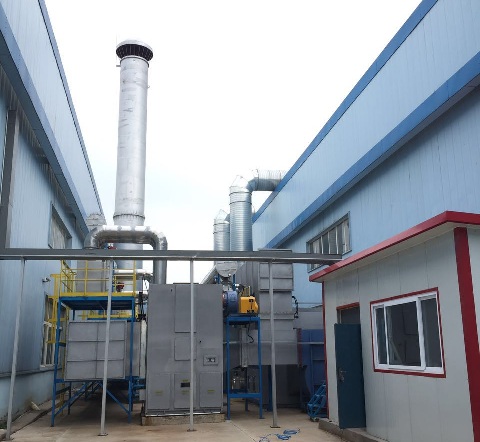
The VOCs purification efficiency of the adsorption-desorption + combustion method can reach over 95%, and the excellent purification rate can reach 98%.