Huashijie HTR Brand RTO - Regenerative Thermal Oxidizer
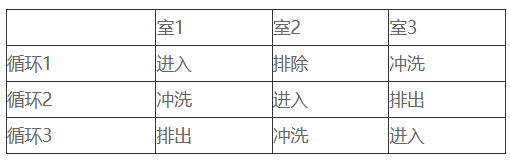
Table 1-1 Work Procedure for Three-Bedroom RTO
2. Basic Parameters of RTO Equipment
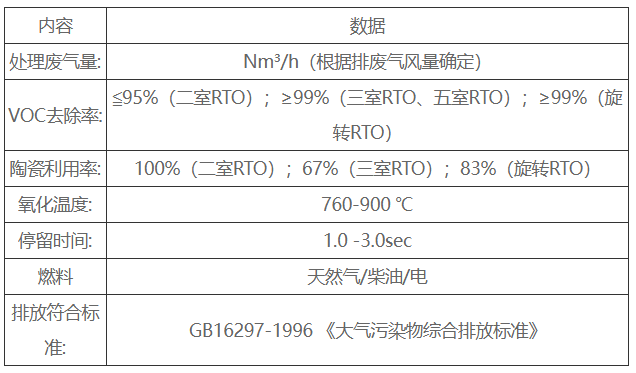
The basic parameters of the RTO equipment are shown in Table 2-1 as follows:
Table 2-1 Basic Parameters of RTO Equipment
RTO - Regenerative Thermal Oxidizer
Thermal oxidation is a method that uses thermal oxidation and catalytic oxidation technologies to destroy organic compounds in the emissions. The Regenerative Thermal Oxidizer (RTO), abbreviated as RTO, is used to treat medium and low concentration organic gases (VOCs). The common forms of RTO equipment for handling VOCs include two-chamber RTO, three-chamber RTO, and rotary RTO. According to customer requirements, it can also be designed in five-chamber RTO, seven-chamber RTO, and other structural forms. Huashi Jie RTO equipment, relying on a strong research team and technical support from various universities and research institutes, has rich project development experience in the industry. The components of the equipment, such as the heat storage device, burner, control, and instruments, all use high-end products from domestic and foreign sources.
1. RTO Process Principle
The working principle of RTO: Organic compounds (VOCs) react with oxygen at a certain temperature to form CO2 and H2O and release a certain amount of heat. RTO heats the exhaust gas to above 700°C to oxidize and decompose the VOCs into CO2 and H2O. The oxidized hot gas flows through the ceramic heat storage body, causing it to heat up and "store heat", and is used to preheat the subsequent organic exhaust gas, thereby saving fuel consumption for heating the exhaust gas.
1.1 Rotating RTO Working Principle
The heat storage body of the rotating RTO is equipped with partition plates, dividing the heat storage body bed layer into several independent fan-shaped zones. The exhaust gas enters the preheating zone from the bottom through the air distribution device, preheats the gas to a certain temperature, and then enters the top combustion chamber and is completely oxidized.
The purified hot gas leaves the oxidation chamber and enters the cooling zone, transferring heat to the heat storage body and cooling the gas. The gas is then discharged through the gas distribution device. The ceramic heat storage body in the cooling zone absorbs heat, "stores" a large amount of heat (for the next cycle to heat the exhaust gas).
To prevent unreacted exhaust gas from entering the purification gas outlet with the rotation of the heat storage body, there is a fan-shaped zone as a flushing zone before the heat storage body rotates to the purification outlet zone.
Through the rotation of the heat storage body, the heat storage body is periodically cooled and heated, while the exhaust gas is preheated and the purification unit is cooled. This process alternates continuously.
1.2 Two-chamber RTO Working Principle
When starting, fresh air replaces the organic exhaust gas, and the burner heats the heat storage chamber to a certain temperature. Due to the high heat storage performance of the heat storage body, it takes a certain time to heat from a cold RTO to a certain high temperature and achieve a normal temperature distribution.
During normal operation, one heat storage chamber has stored heat in the previous operation cycle, and the organic exhaust gas first enters this heat storage chamber. The exhaust gas is preheated to a temperature close to the combustion temperature through the heat storage body bed layer, while the heat storage body is gradually cooled.
The preheated exhaust gas enters the top combustion chamber, where the organic compounds are oxidized and then as high-temperature purified gas enters the other heat storage chamber. At this time, the heat of the purified gas transfers to the heat storage body, and the heat storage bed layer gradually heats up, while the purified gas is cooled and discharged. When the cooled heat storage body cools to a permissible temperature level, the gas flow direction should be switched, completing the first cycle.
After the switch, the organic exhaust gas enters the heated heat storage chamber, and the reacted purified gas transfers heat to the cooled heat storage chamber from the previous cycle. As described above, it completes the second cycle.
1.3 Three-chamber RTO Working Principle
The principle of simultaneous operation of the heat storage chambers in the three-chamber RTO: When the first heat storage chamber is in the cooling stage and the exhaust gas is preheated (cold cycle), the second heat storage chamber is in the process of being heated by the purified gas (hot cycle), and the third heat storage chamber is in the flushing (cleaning cycle). Therefore, after each cycle, the exhaust gas always enters the heat storage chamber that discharged the purified gas in the previous cycle. The heat storage chamber that originally received the exhaust gas is then flushed with purified gas (or air), and the remaining unreacted exhaust gas is sent back to the reaction chamber for oxidation. Then, together with the purified gas, it is discharged from the flushed heat storage chamber.
3. Characteristics of RTO Equipment
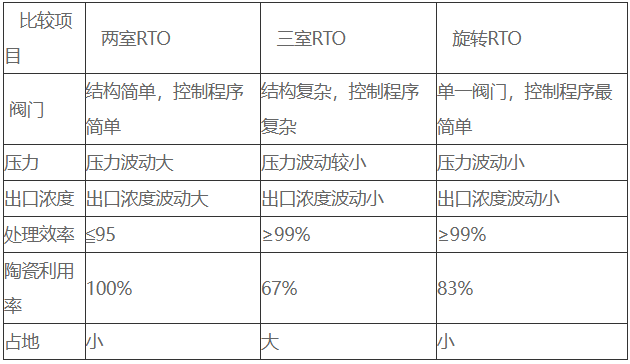
The comparison table of the characteristics of two-chamber RTO, three-chamber RTO, and rotary RTO equipment is shown in Table 3-1:
Table 3-1 Comparison Table of Characteristics of Three Types of RTO Equipment
The features of the RTO equipment designed by Huashi Jie are as follows:
1) The product design takes into account the customer's production process, emphasizing the combination of front-end control and end-stage treatment;
2) The high-performance ceramic material heat storage body has a heat exchange efficiency of up to 95%;
3) The purification efficiency is high, with both the three-chamber RTO and the rotating RTO being able to reach over 99%;
4) The waste heat is fully utilized to generate economic benefits;
5) The optimized ceramic structure and ventilation system ensure the best treatment effect and user experience;
6) The safety and protection of the system are fully considered, providing customers with safe and reliable post-extraction equipment and technologies.