Overview of VOCs Control in the Furniture Industry - Molecular Sieve Wheel Technology
With the improvement of human living standards and the increasing attention to the quality of living environment, wooden furniture has become increasingly popular among the public. However, the large amount of VOCs gas produced during the production of wooden furniture is irritating or toxic, serving as precursors to PM2.5 and ozone, and causing the aggravation of air pollution such as haze and photochemical smog. Therefore, the National "Key Regional Air Pollution Prevention and Control Plan" and the "Opinions on Implementing the Blue Sky Project to Improve the Atmospheric Environment" of the Jiangsu Provincial Government have both regarded the control of volatile organic compounds as a key area for air pollution prevention and control.
1. Current situation of VOCs emissions in the furniture manufacturing industry
The production process of furniture mainly consists of many steps such as material preparation, machine processing, surface treatment, paint coating, and product packaging or assembly. The volatile organic gases produced during the production process mainly come from the volatilization of solvents in coatings and organic components in auxiliary materials, and the volatile organic compounds mainly include: toluene, xylene, formaldehyde, phenolic compounds, paint mist, and other VOCs. According to the preliminary analysis report on VOCs emissions in the furniture manufacturing industry in Jiangsu Province (statistics for 2010): there are 13 furniture manufacturing enterprises in Jiangsu Province, including 6 wooden furniture manufacturing enterprises, 6 metal furniture manufacturing enterprises, and 1 other furniture manufacturing enterprise. The annual usage of organic substances related to raw materials and auxiliary materials of these enterprises: paint is 578.6 tons; powder coating is 120 tons; glue is 270 barrels. The total amount of organic solvents used is approximately 7.256 million tons. Based on a 60% evaporation rate of coatings, the total VOCs emissions from the furniture manufacturing industry are approximately 471.5 tons. According to statistics, there are over 2,700 furniture enterprises registered in Shenzhen in 2011, which shows that the annual VOCs emissions from the furniture industry across the country cannot be ignored. 2. Control plans for VOCs emissions from furniture manufacturing enterprises
The VOCs emissions from furniture production mainly come from the volatilization of solvents. There are two types of corresponding control plans for VOCs: one is to implement clean production and control from the source; the other is to effectively treat the generated VOCs.
2.1 Implementing clean production to control VOCs emissions from the source
A large amount of volatile organic gases in furniture production mainly come from the volatilization of solvents in coatings and organic components in auxiliary materials. Therefore, for furniture enterprises, the top priority is undoubtedly to control the source, that is, to control the raw materials of the coating process and have enterprises prioritize the use of environmentally friendly water-based paints or UV paints for coating process upgrades, thereby reducing VOCs emissions to the atmosphere. In fact, in 2011, Shenzhen promoted this solution for the furniture industry, such as furniture manufacturing enterprises like Dahao Xingli, Hong Apple, and Qicai Rensheng have adopted water-based paint coating processes, and processes such as PE base water-based surface and UV base water-based surface, combined with roller coating and spraying, have been used in many enterprises, and significant success has been achieved in reducing volatile organic compounds emissions in this regard.
When furniture is produced using artificial boards as raw materials, the boards used must meet the requirements. During the manufacturing process of artificial boards, urea-formaldehyde, phenolic, and melamine-formaldehyde resins are used as adhesives, of which urea-formaldehyde resin is the most commonly used. It is formed by the condensation of urea and formaldehyde, and a large amount of free formaldehyde is released during the manufacturing and gluing process. Therefore, the formaldehyde release of the selected artificial boards should meet the requirements of "Indoor Decoration and Renovation Materials - Formaldehyde Release Limit for Artificial Panels and Their Products" (GB18580 - 2001); the quality of the coatings should comply with the relevant requirements of "Harmful Substance Limit for Solvent-based Wood Coatings for Indoor Decoration and Renovation Materials" (GB18581 - 2001); the hard regulations for adhesives can refer to the regulations in "Indoor Decoration and Renovation Materials - Harmful Substance Limit for Adhesives" (GB 18581 - 2001).
2.2 Effective Treatment of Emitted VOCs
The paint mist from the paint workshop is the most significant source of VOCs emissions during the furniture production process. The paint mist mainly consists of particulate pollutants and volatile organic gases as the main pollutants, among which the main components of the organic gases are benzene compounds, ester compounds, etc.
For particulate pollutants such as paint mist, common treatment methods include spray, water film, and impact treatment methods, but the efficiency is low. The commonly used water curtain cabinets can improve the working environment to some extent and purify some particulate pollutants, but they have little effect on gaseous pollutants and will also cause secondary water pollution.
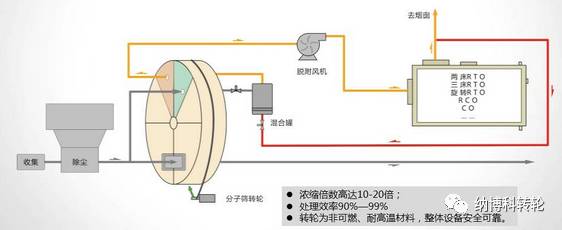
Commonly used methods for purifying organic gases include condensation, combustion, adsorption, and absorption. Condensation, combustion, and adsorption have the advantages of high purification efficiency and thorough treatment. For low-concentration organic gases in the furniture production process, the traditional direct condensation method and combustion method have lost practical significance. For low-concentration and high-volume organic gases, Naboco Environmental Protection has proposed the process of molecular sieve rotor + thermal oxidation for treatment.
3 Conclusion
After comparing the two solutions for reducing volatile organic gas emissions in the furniture industry, it is clearly evident that implementing clean production is the only way to solve the problem of volatile organic gas emissions in the furniture industry. Therefore, furniture enterprises should pay attention to the following points when reducing VOCs emissions:
(1) Use solvent-free or low-solvent paints, such as water-based paints and UV-cured paints; the adhesives must meet environmental certification standards or be partially or fully replaced by water to reduce solvents, and use air spraying to increase the utilization rate of the paint;
(2) The spray painting environment should be reasonably designed. The wind speed in the spray booth should be maintained at 0.3 to 0.5 m/s. The temperature in the coating room should be 15 to 20℃ in winter and 25 to 30℃ in summer, with a relative humidity maintained at 50% to 80%. The partitions of the coating room should eliminate the swirling airflow. To prevent external polluted air from invading, there should be a slight negative pressure in the coating room and a filter should be set. To prevent the coating room from being affected by resonance of the exhaust device, fans, exhaust fans, etc. should use devices that do not directly connect to the main body;
(3) A water curtain should be set up to recover organic volatile substances. The water curtain paint mist absorption and discharge device, namely the water curtain cabinet, is equipped with a water pump, exhaust fan, water tank, water curtain, etc. Its absorption principle is: during the spraying operation, the sprayed paint mist is sent to the water curtain wall by the airflow, and then the water curtain on the water curtain wall washes it to the bottom trough, and the gas is discharged through the exhaust fan to the outdoor pipeline;
(4) The painting, drying, and bonding processes of the furniture should be carried out in the workshop. The volatile organic gases emitted should be collected by the ventilation system and then enter the purification device;
(5) After using the coatings, paints, and adhesives, the containers should be sealed immediately to prevent spillage;
(6) Painted furniture should not be stored outdoors and should be promptly stored in the warehouse. The warehouse should have a gas collection and purification device.