01 - Napotec® | Molecular Sieve Wheel Adsorption Concentration Principle
Global supplier of environmental protection equipment and core materials, Qingdao Nabok Environmental Technology Co., Ltd., has achieved international advanced levels in VOCs treatment technology and product performance. The first molecular sieve adsorption concentration wheel in China, which is a technological innovation, provides clean and comfortable air for people's lives! Now, we are launching "Le Chant VOCs", regularly sharing VOCs treatment technology, international environmental protection trends, customer cases, and the joys and hardships of environmentalists with everyone. We hope to share a happy and environmentally friendly life with you.
Whether you are a research institute, environmental protection enterprise, engineering company, an enterprise or individual with a passion for environmental protection, we sincerely invite you to join the Nabok Club to share research results, jointly undertake the responsibility of VOCs treatment, and protect the same blue sky.
Everyone knows PM2.5, which refers to particles with an equivalent diameter of less than or equal to 2.5 micrometers in the air. However, perhaps you don't know that before PM2.5 forms, there is another most important precursor substance - VOCs (volatile organic compounds), and VOCs are also an important precursor substance for the formation of secondary organic aerosols and ozone, causing haze and photochemical smog and other atmospheric problems. So, it is necessary for us to understand the definition of VOCs.
Definition of VOCs (Volatile Organic Compounds)
VOCs (volatile organic compounds) refer to organic compounds that are prone to volatilize at normal temperatures. Under normal conditions (20℃, 101.3 kPa), the vapor pressure is above 0.1 mmHg (13.3 Pa), and the boiling point is below 50 - 260℃. Organic substances of various types, including various hydrocarbons, aliphatic hydrocarbons, aromatic hydrocarbons, acids, esters, alcohols, ketones, halogenated hydrocarbons, etc., are included. Due to the countless variations of VOCs, fine particulate matter pollution has become increasingly serious. With the acceleration of industrialization, the total VOCs emissions in China have been increasing year by year. As people's environmental requirements gradually increase, in recent years, the government has also begun to implement policies to control VOCs emissions. Research on VOCs treatment and application has become increasingly active. For low-concentration, large-volume exhaust gases accounting for 60% of the market emissions, the core technology of molecular sieve adsorption concentration wheels is usually treated by an adsorption concentration + thermal oxidation combination process. The core technology of the molecular sieve adsorption concentration wheel is only mastered by a few enterprises in Sweden and Japan. Our company has developed the first molecular sieve adsorption concentration wheel in China, which has independent intellectual property rights. Key performance indicators have reached or exceeded imported products and have achieved large-scale production. This time, we will first explain the principle of the molecular sieve adsorption concentration wheel.
Introduction to Molecular Sieve Adsorption Concentration Wheel
The molecular sieve adsorption concentration wheel is a rotating adsorption equipment made by attaching molecular sieve adsorption materials to honeycomb-shaped porous carriers. The adsorption materials used in Qingdao Nabok Environmental Technology Co., Ltd. (hereinafter referred to as Napotec®) are inorganic honeycomb hydrophobic zeolites (molecular sieves), so it is usually called zeolite wheel or molecular sieve wheel, as shown in Figure 1 below.
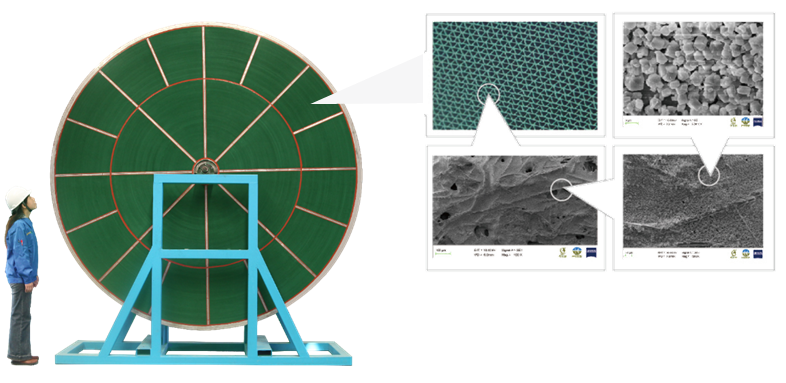
Figure - 1 Napotec® Molecular Sieve Adsorption Concentration Wheel
The principle of molecular sieve wheel adsorption and concentration
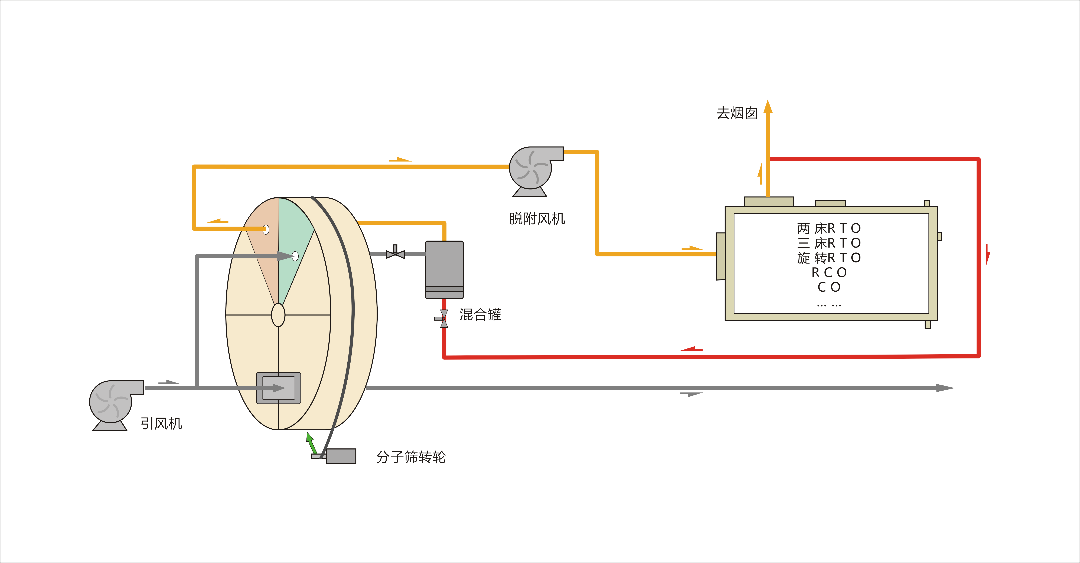
The molecular sieve adsorption concentration wheel is divided into the adsorption zone, the desorption zone, and the cooling and regeneration zone. The wheel rotates continuously at a certain speed. Please refer to Figure - 3 and Figure - 4 for details:
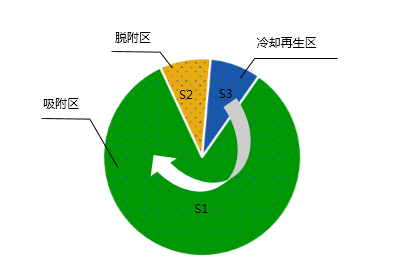
Figure - 3 Schematic Diagram of the Napotec® Molecular Sieve Wheel Principle
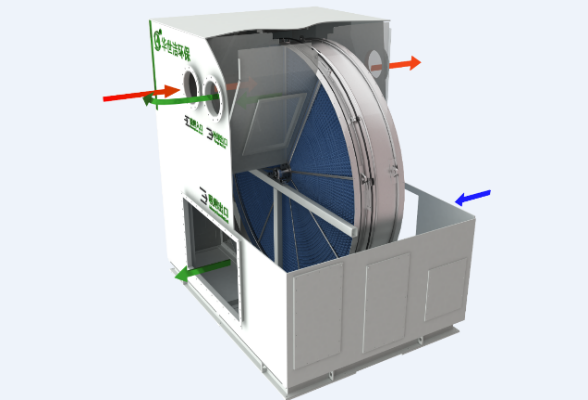
Figure - 4 Physical principle diagram of Napotec® molecular sieve rotor
The following sections will provide detailed explanations:
Adsorption Zone: After VOCs exhaust gas is pre-treated by multiple filtration devices, it enters the adsorption zone of the molecular sieve rotor for adsorption (refer to Figure - 5). The clean gas purified by zeolite molecular sieves is directly discharged into the atmosphere through the chimney;
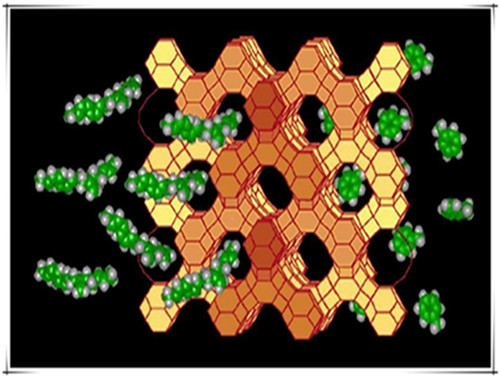
Figure-5 Schematic Diagram of Molecular Sieve Adsorption of VOCs
Desorption Zone: Before the molecules in the adsorption zone of the molecular sieve reach saturation, the rotating wheel moves to the desorption zone. Using hot air at a temperature of 180-220°C for desorption and concentration, the desorption temperature can reach up to 350°C during operation. Based on the composition and concentration, a certain rotation speed is designed to achieve high purification efficiency. Additionally, according to the different operating conditions of the customers, the adsorption speed and desorption speed can be adjusted to achieve the desired VOCs concentration ratio (n = (S1×V1) / (S2×V2) = 5-30), minimizing the operating energy consumption to the greatest extent.
Cooling and Regeneration Zone: The desorbed molecular sieve rotating wheel enters the cooling and regeneration area. It is cooled and regenerated by cold air or cold exhaust gas. The regenerated molecular sieve rotating wheel then rotates to the adsorption zone, continuously adsorbing VOCs exhaust gas, repeating this process continuously for operation.
Application Case Sharing
Customer Information
Project Name: Waste Gas Purification Solution for the Painting Line of a Certain Automobile Company in Chongqing
Original Operating Conditions: The main components of the waste gas produced by the painting line of the factory are: benzene, esters, alcohols, ketones, alkanes, etc. The exhaust gas volume: 450,000 m³/h, exhaust gas concentration: 90 mg/m³;
Design Results
Treatment Process: Molecular sieve adsorption concentration wheel + RTO
Molecular sieve load: Adsorption 680,000 m³/h
Molecular sieve adsorption efficiency: ≥ 90%
Treatment Effect: "Integrated Emission Standard for Air Pollutants" GB16297-1996
Next part is more exciting: The advantages of Napotec®'s independently produced molecular sieve concentration wheels, stay tuned...