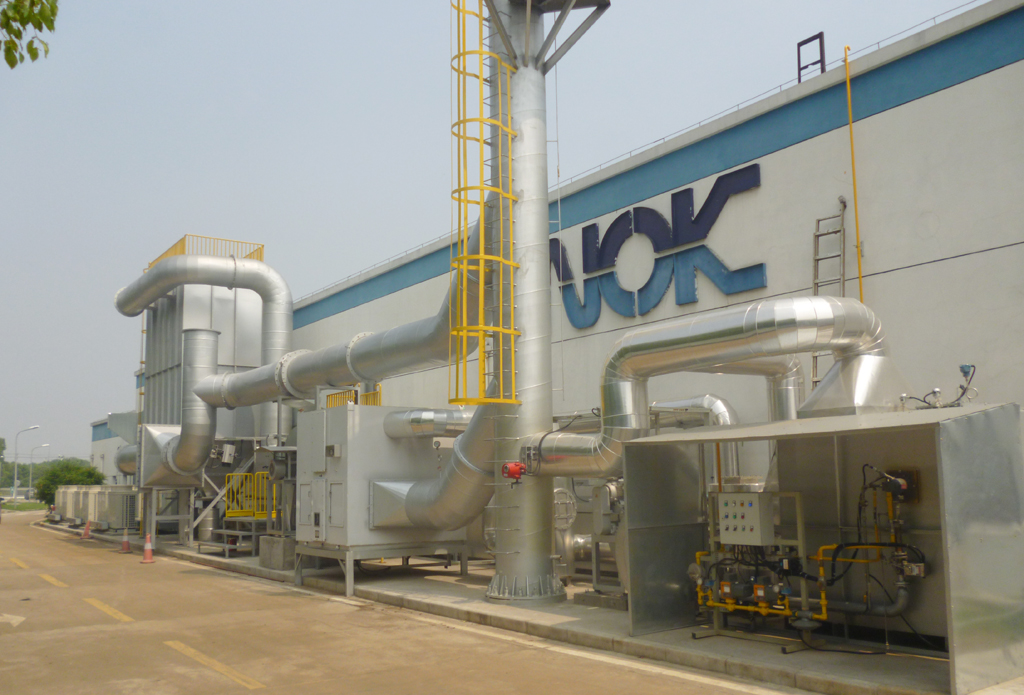
【Original】Introduction to Nabok Zeolite Rotating Disk Technology and Process
【Original】Please indicate the source when reusing.!
1. Introduction to Naboco Zeolite Rotating Disk Technology
Naboco Zeolite Rotating Disk technology uses a zeolite honeycomb rotating disk made of ceramic fiber paper as the adsorption medium. It employs the combined treatment technology of adsorption concentration and heat storage catalytic oxidation to first adsorb and concentrate the organic waste gas with a large volume and low concentration, and then through hot air to desorb the adsorbent, concentrating it into a small volume and high concentration of organic waste gas. The concentrated waste gas is oxidized under low-temperature catalytic conditions to generate non-polluting CO2 and H2O. The heat generated by the oxidation of organic substances is used for heat exchange and reuse, with a portion used for desorption of the adsorbent and the remaining part utilized as residual heat energy.
The key technical contents of Naboco Zeolite Rotating Disk technology for adsorption concentration and heat storage catalytic oxidation coupling treatment are as follows:
1) Forming processing of honeycomb structure using ceramic fiber paper as the raw material
The strength, fiber diameter, thickness, and initial ecological structure (such as elemental composition, slag particle number) of ceramic fiber paper will all affect the density, porosity, and strength of the supporting structure and the final performance of the zeolite rotating disk. Naboco Zeolite Rotating Disk technology, based on the concept of system design, aims to achieve a high-performance ceramic fiber paper-based zeolite honeycomb rotating disk as the target, starting from the source of ceramic fiber paper, precisely characterizing the strength, fiber diameter, thickness, and initial ecological structure (such as elemental composition, slag particle number) of ceramic fiber paper, establishing the relationship between the ceramic fiber paper rotating disk structure and process parameters and the performance of the rotating disk, thereby enabling a comprehensive evaluation of the adsorption performance of the rotating disk. Currently, the overall performance of ceramic fiber paper as one of the raw materials still has a significant gap compared to foreign products. In the absence of a short-term solution to this problem, by improving the process, optimizing the design, and leveraging the relative advantages of existing materials, while reducing the influence of unfavorable factors, a good material foundation can be provided for the formation of the honeycomb structure. Based on the development of existing equipment, using fluid mechanics software simulation, the optimization design of the honeycomb structure is completed. In-depth analysis and comparison of existing designs and working principles at home and abroad, designing and developing a large-capacity support structure to minimize system energy consumption and operating costs to the greatest extent.
2) Selection and design of zeolite adsorbents
There are many types of zeolites used in preparing zeolite rotating disks. The formulation design mainly depends on the composition of the VOCs to be treated. Due to differences in molecular size, polarity, and reactivity, appropriate types of zeolites with suitable pore sizes and surface polarities need to be selected to achieve the desired effect. Based on the requirements of use and economic benefits, the relevant parameters such as surface area and pore volume of the zeolite need to be screened. For complex-component VOCs, in addition to considering the adsorption effect of the main components, the competitive adsorption effect of each component also needs to be considered, and a targeted, wide-applicable, and strong-tolerant zeolite adsorbent formulation needs to be designed.
3) Immersion process of zeolite adsorbents
There are various methods for attaching the adsorbent to the supporting material. Among them, the immersion method is the most mature and widely used method. The formed rotating disk is immersed in the zeolite dispersion solution, dried, and then a layer of zeolite is attached to the surface. The preparation of the zeolite dispersion solution involves many factors such as the hydrophilicity and hydrophobicity of zeolite, the degree of agglomeration of zeolite, the particle size distribution of zeolite, the stability of the suspension, and the fluctuations in materials during the production process, all of which will directly affect the adsorbent loading of the rotating disk and the final adsorption effect of the zeolite rotating disk. Through detailed investigation of these factors, the causal relationship between them and the adsorption effect is established.
4) Optimization of zeolite rotating disk system and energy recovery technology
The traditional catalytic combustion device has problems such as large temperature fluctuations during the reaction, easy high-temperature sintering and deactivation of the catalyst, and low system thermal efficiency. To solve this problem, a regular ceramic regenerative bed is set in the catalytic bed to stabilize the temperature in the combustion chamber, reduce the temperature fluctuations in the combustion chamber caused by the changes in the heater and reactant concentration, improve the catalyst activity and stability, extend the service life of the catalyst, and reduce the amount of catalyst used. At the same time, the reaction tail gas, after being heated and exchanged with the incoming reactant gas, has a relatively low temperature, which is a typical low-grade heat source. By using new efficient heat exchange devices such as honeycomb full-effect heat exchangers, the level of residual heat utilization can be improved.
2. Introduction of the Zeolite Wheel Process
This product adopts the zeolite adsorption concentration wheel - regenerative catalytic combustion technology. According to the process flow classification, the overall process can be divided into two parts: the exhaust gas concentration process and the exhaust gas combustion process. The overall process flow diagram is shown in Figure 1.
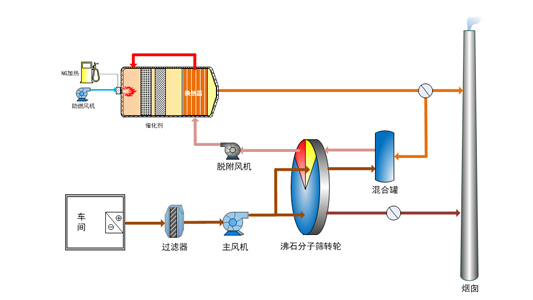
Figure 1 Process Flow Diagram of Zeolite Rotating Disk Adsorption Concentration - Regenerative Catalytic Combustion
The high-concentration condensation of exhaust gas mainly relies on zeolite rotors. For large-volume, low-concentration VOCs exhaust gas, it first enters the pre-treatment equipment to filter out the particulate matter mixed in the organic waste gas; when the particle content meets the standard, the exhaust gas will pass through the adsorption area of the zeolite rotor, where the exhaust gas components are adsorbed by the adsorbents in the rotor, and the rotor gradually becomes saturated; at this time, the treated exhaust gas is purified and discharged. Meanwhile, in the regeneration area, hot air passes through the adsorbed saturated rotor, causing the adsorbed exhaust gas to be desorbed and carried away by the hot air, thereby restoring the rotor's adsorption capacity and achieving continuous removal of VOCs. At the same time, the adsorption rotor rotates slowly and continuously throughout the process to ensure the continuity of the process operation and ensure that the adsorption is a continuous process.
The exhaust gas combustion process mainly relies on catalytic oxidation combustion devices. After the low-volume, high-concentration VOCs are condensed by the zeolite rotor, they first enter the heating zone composed of heat storage materials to obtain the necessary energy for the combustion reaction, and the temperature of this part of the heat storage materials drops; subsequently, the exhaust gas enters the catalytic bed layer, where it is fully catalytically burned under low-temperature conditions, converting into compliantly discharged CO2 and H2O, and releasing a large amount of reaction heat; in order to recycle and utilize this reaction heat energy, this gas flow passes through the cooling zone composed of heat storage materials, the energy is retained on the heat storage materials, the heat storage materials heat up, and the gas flow temperature drops, and then it is discharged in compliance with standards. Throughout the process, through the continuous heat exchange of the heat storage ceramic materials, the reaction heat is recycled and utilized, thereby achieving the purpose of saving fuel consumption.