To win the tough battle against air pollution, Shandong has introduced three new mandatory standards. What have these standards changed?
This year's main event of the World Environment Day was held in Hangzhou. At the meeting, the Ministry of Ecology and Environment will release the "Resolutely Winning the Battle for Blue Skies - China's Air Quality Improvement Report (2013-2018)" to share China's experience and practices in the "Battle for Blue Skies" with other countries. This also indicates the international community's recognition of China's air pollution control plan.
Since the implementation of the "Air" in 2013, all regions across the country have been vigorously promoting air pollution control. So far, remarkable achievements have been made. The director of the Atmospheric Environment Department of the Ministry of Ecology and Environment, Liu Bingjiang, said that not only the average PM2.5 concentration in key regions such as Beijing-Tianjin-Hebei has been decreasing, but also from the perspective of the completion of the air quality constraints indicators in the "13th Five-Year Plan", all have exceeded the scheduled progress and annual target requirements. 2018 was the first year of the "Battle for Blue Skies", and the battle situation was excellent, marking a "good start" for the following two years.
"Scientific policy implementation, comprehensive treatment of both symptoms and root causes, and tough governance" are the "battle plans" given by the government. Each city has tailored measures according to local conditions, highlighting the key areas of governance, covering multiple aspects such as the steel industry, industrial furnaces, coal pollution, and motor vehicle emission management. They are all advancing pollution source governance with the aim of "breaking through tough problems".
To win the "Battle for Blue Skies", Shandong Province has not slackened at all. Recently, the Shandong Provincial Department of Ecology and Environment and the Market Supervision Administration jointly released three mandatory environmental protection local standards: "Regional Comprehensive Emission Standards for Atmospheric Pollutants", "Emission Standards for Atmospheric Pollutants from Industrial Furnaces", and "Emission Standards for Atmospheric Pollutants from the Steel Industry". All three standards have been adjusted and increased, and will be implemented from November 2019.
"Regional Comprehensive Emission Standards for Atmospheric Pollutants"
Scope of application adjustment: This standard clearly specifies the adjustment of the scope of application, changing the original "applicable to all fixed-source construction projects in Shandong Province" to "applicable to the atmospheric pollutant emission management of existing enterprises or production facilities in Shandong Province, as well as new, renovated, and expanded projects". In addition, it is proposed that this standard does not apply to enterprises or production facilities such as thermal power plants, steel industries, cement chemical industries, rubber manufacturing industries, and synthetic leather industries.
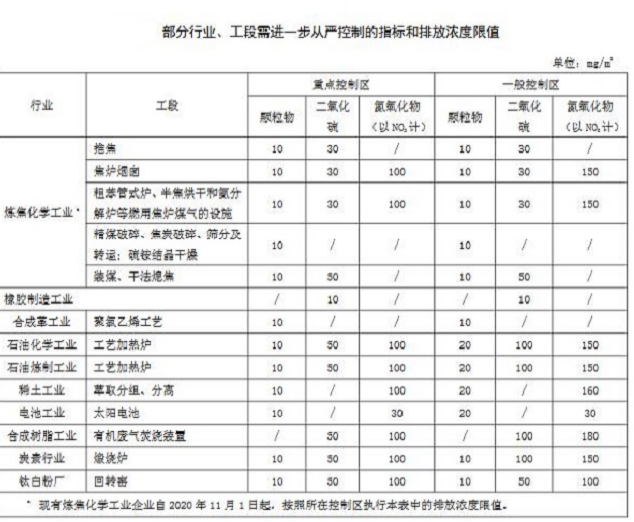
Pollutant emission limits adjustment: Leaving aside the previously established "first period", "second period", and "third period", new and existing enterprises will directly implement the original "fourth period" pollutant emission concentration limits starting from November. In terms of industry classification, compared with the original "thermal power plants, steel industries, coking chemical industries, rubber manufacturing industries, and synthetic leather industries", the categories are more diverse, and the main industries such as "petrochemical industries, rare earth industries, and battery industries" have been added, and the emission limits have also been reduced.
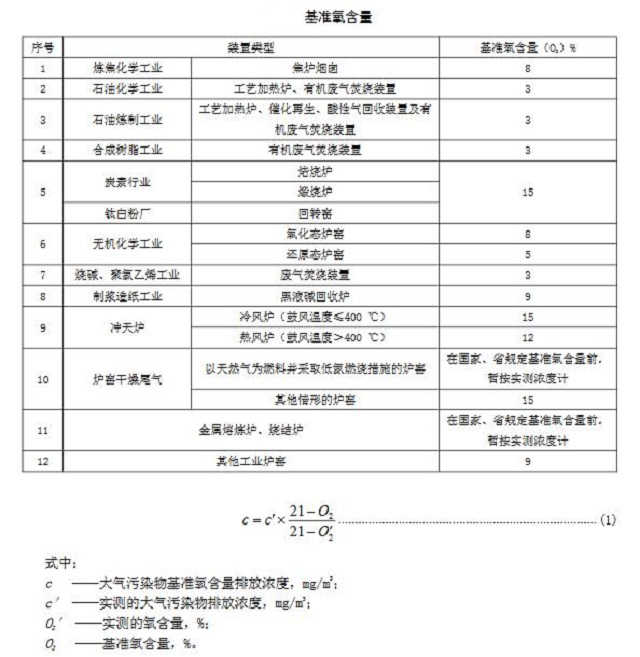
Baseline oxygen content adjustment: The baseline oxygen content has redefined the said industry, no longer being confined to thermal energy conversion facilities such as power plants, boilers, and industrial furnaces. It has also encompassed industries like petroleum, inorganic chemistry, and papermaking. It is highly specialized and targeted, with a more defined scope.
"Industrial Furnace and Kiln Atmospheric Pollutant Emission Standards"
Emission concentration limits for some pollutants: The emission limit for lead and its compounds (in metal smelting furnaces) in this standard has been changed from "0.7mg/m3" to "0.5mg/m3"; for cadmium and its compounds, the classification has been refined. The emission limits for tin, antimony, and mercury industries, as well as for recycled copper, aluminum, lead, and zinc industries, are set at 0.05mg/m3, while for other furnaces, it is 0.8mg/m3; the standard also adds a limit for chromium and its compounds (1.0mg/m3).
Reference oxygen content: Not to mention the excessive content, just a glance shows that the reference oxygen content in this standard is significantly higher than that of the previous one. The reason for this significant difference is that the reference oxygen content is no longer limited to the type of furnace and kiln, but is more focused on being specified according to the industry, and the types of equipment are more diverse.

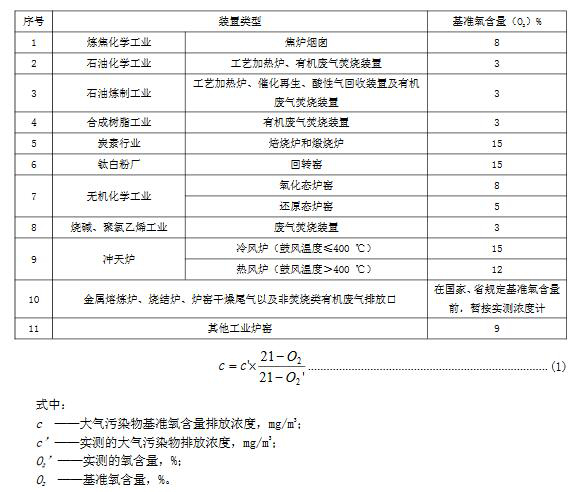
"Steel Industry Air Pollutant Emission Standards"
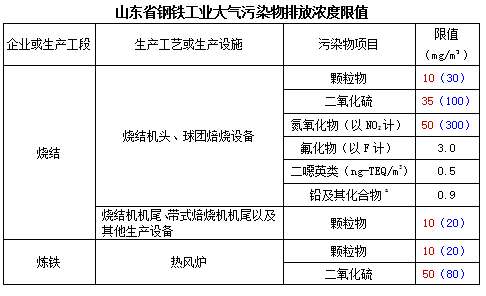
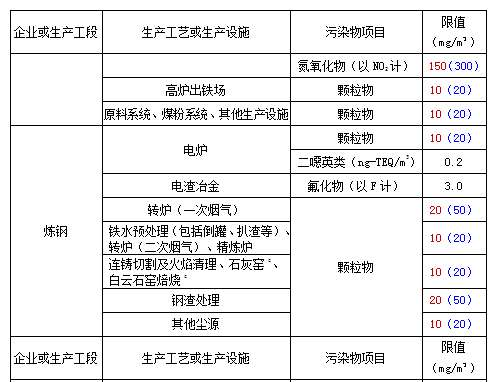
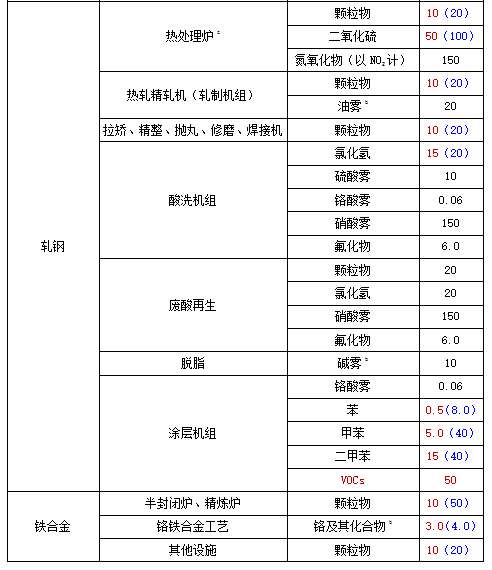
Adjustment of pollutant emission limits: In the standard, the control requirements for water pollutants in the original standard have been removed. It is worth noting that in Shandong Province, there is a mandatory unified requirement for newly established enterprises to implement the emission concentration limits in this standard starting from the implementation date of the standard. For existing enterprises, the implementation will start from November next year. The emission concentration limits for some air pollutants have been adjusted, which is more stringent compared to the original standard. Many of the limits have been reduced by half or more. As shown in the figure below, the blue color represents the original emission restrictions:
 In addition, the three standards clearly define the methods for determining compliance: If the monitoring results obtained by the environmental protection departments at all levels according to relevant manual monitoring technical specifications exceed the emission concentration limits set by these standards, it is determined as exceeding the emission limit; for the determination of compliance under special working conditions, it shall be carried out in accordance with relevant national regulations. It is clearly pointed out that among the pollution discharge units in the steel industry, for the sintering machines/balling roasting facilities that adopt denitrification measures, the 8-hour period during which they are started shall not be regarded as the period for determining nitrogen oxide compliance.