What exactly is the process of identifying the sources of VOC pollution?
It is well known that the impact of VOCs on the environment includes not only photochemical smog and surface ozone, but also the unpleasant odor. Especially for manufacturing enterprises, the primary reason for receiving complaints from residents is usually the peculiar foul smell of VOC substances.
In fact, most VOCs have an odor. Some have a low odor threshold, such as mercaptans, esters, organic acids, aldehydes, amines, etc. At a concentration of 0.1 mg/m3, they still have a noticeable odor. These substances are commonly found in industries such as petrochemicals, pharmaceuticals, synthetic resins, waste treatment, and chemical plants. The Chinese Odor Pollutant Emission Standard (GB14554-1993) defines eight odor pollutants, and six of them belong to VOCs. After identifying the source of the odor, through control and management measures, most can be effectively controlled. However, how to find and determine the source of the odor is the first step in solving the odor problem and is often the most difficult issue.
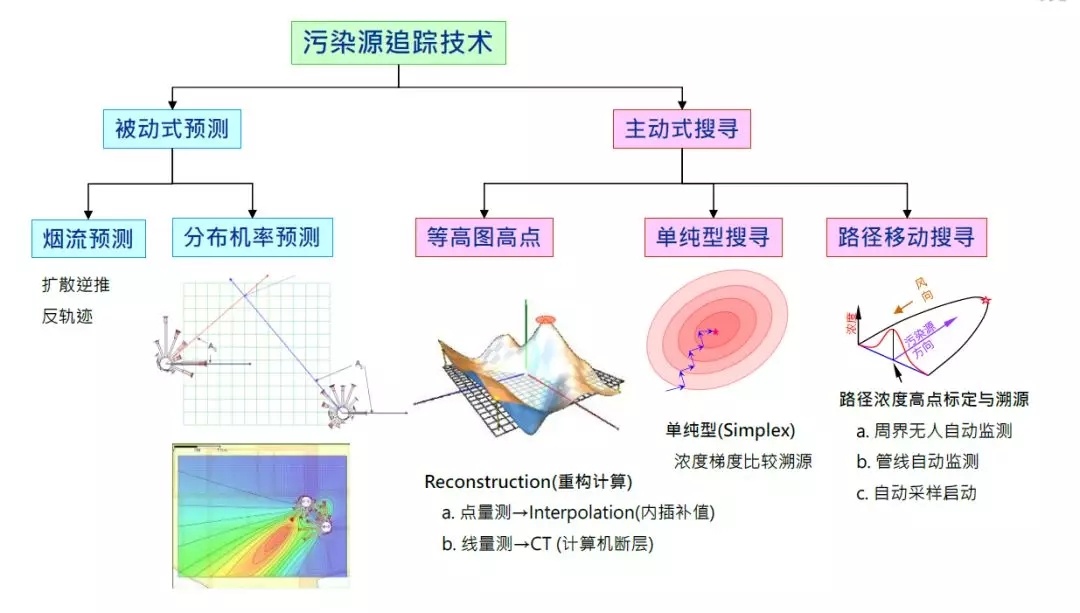
VOCs odor pollution source tracing technology is the comprehensive application of pollutant concentration monitoring results. Its principle is to use the monitoring results of point or line monitoring equipment, combined with wind direction data, to calculate the probability distribution of pollutants in space, or to use appropriate route planning to move the measurement position to achieve the purpose of locating the pollution source. Based on the current technological development status of domestic and foreign countries, pollution source tracing technology can be roughly divided into passive and active types (as shown in the following figure). Common active search methods include contour map high points, simple search, and path movement search. Passive prediction methods include smoke flow prediction and distribution probability prediction, etc.
(1) Active Search
The contour map high-point method uses a large number of point monitoring or line monitoring devices to obtain sufficient data. After that, a contour map of the concentration distribution of pollutants in a specific space is calculated, and then the location of the pollution source is determined based on the high-point area of the contour map. This method requires the use of a large number of hard equipment to achieve good results. The simple search and path movement search methods do not require a large number of monitoring devices, but instead, mobile monitoring devices are moved to collect pollutant concentration data at different locations, and then the information of the concentration distribution is further calculated. Using these two methods is prone to the problem of long measurement intervals and inconsistent concentration distributions before and after. They are suitable for application in areas where pollutant concentrations are stable and distribution changes are small.
(2) Passive Search
The distribution probability prediction method does not use the concentration distribution method, but instead uses the probability of pollutant occurrence at measurement points in all directions to calculate the dispersion location of the pollution source. This method does not require a large number of monitoring devices or moving monitoring devices, but requires the combination of meteorological data for calculation. In addition, the smoke flow prediction method uses a small number of monitoring devices, combined with meteorological data or Gaussian diffusion model, to estimate the location of pollution.