What are VOC, VOCs and TVOC? This article will help you clarify them!
What is VOCs?
VOCs is the abbreviation of Volatile Organic Compounds (VOCs), and there are several definitions for it. According to the ASTM D3960-98 standard of the United States, it is defined as any organic compound that can participate in atmospheric photochemical reactions. The United States Environmental Protection Agency (EPA) defines it as: Volatile Organic Compounds are any carbon compounds that participate in atmospheric photochemical reactions except for CO, CO2, H2CO3, metal carbonates, metal carbonates, and ammonium bicarbonate. In China, VOCs (volatile organic compounds) refer to organic compounds that have a saturated vapor pressure greater than 70.91 Pa at standard atmospheric pressure of 101.3 kPa and a boiling point below 50-260℃ and a first boiling point equal to 250 degrees Celsius, or any organic solid or liquid that can volatilize at normal temperature and pressure.
From the perspective of environmental monitoring, VOCs is the general term for non-methane total hydrocarbons detected by hydrogen flame ionization detectors, mainly including alkanes, aromatics, alkenes, halogenated hydrocarbons, esters, aldehydes, ketones, and other organic compounds.
What is the relationship between VOC and VOCs?
VOC and VOCs are actually the same type of substance, namely Volatile Organic Compounds (VOCs), the English abbreviation of which. Since volatile organic compounds generally have more than one component, VOCs is more precise. Moreover, in daily communication, people tend to omit the "s", which causes some friends to be confused about VOC and VOCs.
What is TVOC?
TVOC is the abbreviation of Total Volatile Organic Compounds, which means total volatile organic compounds. The World Health Organization (WHO, 1989) defines TVOC as the general term for volatile organic compounds with a melting point lower than room temperature and a boiling point range of 50-260℃. In China's "Control Standards for Unorganized Emission of Volatile Organic Compounds", TVOC is described as: "Using the prescribed monitoring methods, measuring individual VOCs substances in the exhaust gas, adding them up to obtain the total amount of VOCs substances, measured in the mass concentration of individual VOCs substances. In practical work, the individual VOCs substances that account for 90% or more of the total should be measured and added up to obtain."
What are the sources of VOCs?
(1) Process tail gas emitted by petrochemical plants, such as petroleum refining processes, petrochemical oxidation processes, and petrochemical storage tank production processes;
(2) Oil, coal, natural gas, etc. extraction and storage transportation processes;
(3) Incomplete combustion products of coal, petroleum, petroleum products, natural gas, wood, and tobacco combustion, smoke gas from waste incineration, and hydrocarbon substances in vehicle exhaust that have not been completely combusted;
(4) Indoor decoration and renovation materials such as paints, spray paints and their solvents, wood preservatives, coatings, plywood, etc. can release various volatile organic substances at room temperature;
(5) Cosmetics, organic pesticides, deodorants, disinfectants, preservatives, and various detergents used in daily life can produce volatile organic substances such as phenols, ethers, polycyclic aromatic hydrocarbons, etc.;
(6) Various synthetic materials, organic adhesives, and other man-made products when exposed to high temperatures can produce some low-molecular organic pollutants;
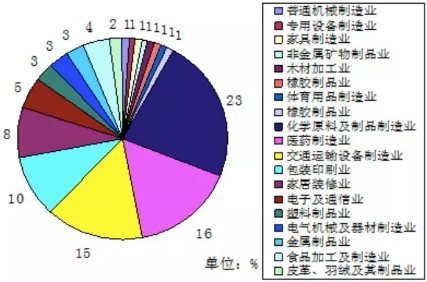
(7) Oxidation and decomposition of starch, fat, protein, cellulose, sugar, etc. can produce some organic pollutants. According to the research results, the industry distribution of industrial VOCs emission sources in our country is as follows
How to control VOCs?
1. The first step in atmospheric environment governance is source control, that is, implementing the substitution of low-VOCs raw materials;
2. Secondly, it is process control, that is, by improving production processes, making the key VOCs generation processes capable of being operated in a sealed manner;
3. Finally, it is necessary to strengthen end-of-pipe treatment, adopting mature and efficient VOCs treatment devices to improve the removal efficiency of end-of-pipe facilities.
This article is excerpted from the "VOCs Online" of the Arctic Star.
The image is from the Internet.
If there are any issues regarding the content, copyright, or other matters, please contact us for deletion.