Advanced technology for treating paint exhaust from furniture manufacturing enterprises - Zeolite rotating wheel adsorption and concentration + thermal oxidation process
The "Emission Standards for Air Pollutants from Wooden Furniture Manufacturing Industry" (DB11/1202-2015) has come into effect. According to the regulations, starting from 2017, the furniture manufacturing industry in Beijing will completely prohibit the use of oil-based coatings, namely paint spraying. This standard is known in the industry as the strictest furniture pollutant emission standard in the country.
1. Furniture Coating Process
(1) Clear lacquer construction process
1. White surface treatment; 2. Apply primer; 3. Fill with putty; 4. Sand and polish; 5. Spray topcoat;
(2) Mixed water-based paint construction process
1. White surface treatment; 2. Mixed water-based paint process; 3. Apply putty on wooden surface; 4. Dry and then sand; 5. Spray transparent putty; 6. Apply primer and topcoat.
(3) Color application by rubbing process
1. Confirm color card and color mark; 2. Apply primer, rub color; 3. Apply topcoat;
II. Current situation of furniture coating
Data shows that 18% of volatile organic compounds are produced by traditional solvent-based paints. The VOC emissions of water-based wood coatings account for only about one-tenth of those of oil-based paints. According to relevant surveys, currently, less than 15% of furniture manufacturing enterprises in the industry use water-based paints. Relevant data shows that among the more than 1,000 furniture manufacturing enterprises in Beijing, at least half are still using oil-based paint spraying. A complete replacement of water-based paints with oil-based paints will increase the production costs of enterprises to a certain extent.
A staff member of a certain brand of paint once said in an interview that it is not the problem of the production capacity of water-based paint enterprises, but that there is not such a large demand in the market. Now, with policy-driven forces, the demand has increased, does this mean that the situation of replacing oil-based paint spraying with water-based paint is within reach? Cost is the most important factor for furniture coating enterprises, how to balance cost and effect is the most troublesome issue for furniture enterprises. "As far as I know, after changing to water-based paint, how to absorb the increased costs is the most headache problem for furniture manufacturers," said Mr. Wang, the sales manager of a water-based paint brand. "Because, more than half of the thousands of furniture manufacturing enterprises in Beijing have the intention to move out, which is not good news for all water-based paint enterprises."
III. Components and hazards of furniture coating exhaust gas
The spraying agent used in the spraying process of the spraying department during the production process is mainly paint, and a certain amount of exhaust gas is discharged. The main components of the exhaust gas are paint dust (fume) and volatile benzene and benzene series substances (commonly known as thinner water).
I. Main pollutants: (1) Fume; (2) Volatile organic exhaust gas
II. Formation and hazards of pollutants:
1. Fume: Liquid paint formed by the action of pressure, in the form of a viscous particle, easily adheres to the person or object it contacts, and is also a potential carcinogen, causing pollution to the entire atmospheric environment.
2. Volatile organic exhaust gas: Organic solvents, mainly trichloroethane (benzene, toluene, xylene), used to dilute paint to achieve a smooth and beautiful surface effect of the object, but the organic solvents are highly volatile and cannot remain on the object surface for a long time. They will all be released during the spraying and drying process, thus forming organic exhaust gas. Its characteristics are colorless, highly irritating, and spreads in the air with the flow, can be inhaled through the human respiratory system or directly act on the human body, causing harm to the respiratory system, blood, heart, lungs, liver, mucous membranes, eyes, nerves, etc., and can also directly harm people through the skin.
IV. Treatment process of furniture coating exhaust gas
Design principles:
(1) The operation of environmental protection equipment does not affect normal production;
(2) Scientific design, reasonable layout, stable operation, environmentally friendly and energy-saving;
(3) Low investment, convenient equipment management and maintenance, low operating costs;
(4) No excessive or insufficient exhaust, no leakage, no leakage;
(5) Ensure that the pollutants are treated and discharged in accordance with standards, without causing secondary pollution;
(6) Advanced technology, considering long-term development.
Zeolite rotating wheel adsorption concentration + thermal oxidation process:
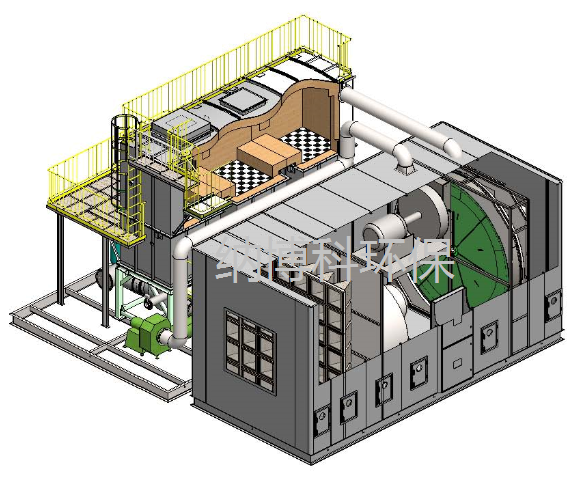
1. Project Name: Tianjin某 Furniture Co., Ltd.
2. Project Time: December 2015
3. Initial Situation: Organic waste gas from processes such as spraying and ovens, main components: toluene, xylene, no high boiling point substances. Rated air volume: 140,000 m³/h, among which E building 90,000 m³/h, G building 50,000 m³/h. Concentration: 80 - 300 mg/m³, average 200 mg/m³. Exhaust time: 14 hours/day, 300 days/year.
4. Process Introduction:
VOCs waste gas is pre-treated by multiple-stage filtration devices, then enters the molecular sieve rotor adsorption area for adsorption. The clean gas after molecular sieve adsorption purification is directly discharged into the atmosphere through the chimney; before the molecular sieve in the adsorption area reaches saturation, the rotor rotates to the desorption area, using high-temperature hot air (180 - 220℃) for desorption concentration (transforming large air volume into small air volume, low concentration into high concentration), the desorbed molecular sieve rotor enters the cooling regeneration area, cooled and regenerated by cold air or cold waste gas, the regenerated molecular sieve rotor rotates to the adsorption area, continuously adsorbs VOCs waste gas, repeating this process continuously, running in a loop; the concentrated organic waste gas after desorption is pumped by the fan to the three-bed RTO for combustion to convert into carbon dioxide and water vapor for compliant discharge.
5. Treatment Process: Molecular sieve rotor + three-bed RTO
6. Treatment Effect: Napotec molecular sieve load: adsorbs 140,000 m³/h
Napotec molecular sieve adsorption efficiency: > 90%
Regeneration efficiency: ≥ 95%
RTO purification efficiency: ≥ 99%
The treated exhaust gas meets the local emission standards of Tianjin DB12/524-2014 "Industrial Enterprise Volatile Organic Compound Emission Control Standards"
7. On-site Equipment Pictures
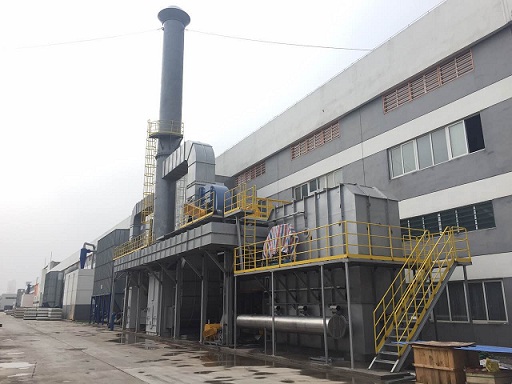
Schematic diagram of the zeolite rotor adsorption concentration + RTO process in the field